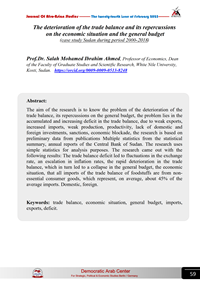
The deterioration of the trade balance and its repercussions on the economic situation and the general budget (case study Sudan during period 2000-8102)
DOI:
https://doi.org/10.63939/JAAS.2025-Vol8.N24.59-85Keywords:
trade balance, economic situation, general budget, imports, exports, deficit.Abstract
The aim of the research is to know the problem of the deterioration of the trade balance, its repercussions on the general budget, the problem lies in the accumulated and increasing deficit in the trade balance, due to weak exports, increased imports, weak production, productivity, lack of domestic and foreign investments, sanctions, economic blockade, the research is based on preliminary data from publications Multiple statistics from the statistical summary, annual reports of the Central Bank of Sudan. The research uses simple statistics for analysis purposes. The research came out with the following results: The trade balance deficit led to fluctuations in the exchange rate, an escalation in inflation rates, the rapid deterioration in the trade balance, which in turn led to a collapse in the general budget, the economic situation, that all imports of the trade balance of foodstuffs are from non-essential consumer goods, which represent, on average, about 45% of the average imports. Domestic, foreign.
References
1 - Ahmed Dwalbeit, Marwa Abdel Qader (2021), The study aimed to measure the impact of food imports on the Sudanese trade balance., White Nile Journal of Studies and Research, Issue (17) March 2021, White Nile University, Sudan.
2 - Ahmed Abdel Rahman Omar (2009), The study dealt with the factors affecting the balance and adjustment mechanisms during the period (1978-2007).
3 - Idris Muhammad Ali Imam, (2011), The study dealt with the impact of the change in the exchange rate on the trade balance in Sudan during the period 2006 - 2010.
4 - Reports of the Central Bank of Sudan, and the Ministry of Finance and Economic Planning, (2000 - 2018).
5 - John Hudson and Mark Hindred, (1987), International Economic Relations, Mars Publishing House.
6 - Hatem Amir Mahran, (2023), Article on Addressing the Trade Balance Crisis in Sudan: Returning to the Roots, Al-Sudani Newspaper, Khartoum, Sudan.
7 - Hafez Ali Mansour, (1990), International Trade Economics, Cairo Library, Egypt
8 - Khaled Al-Habib Al-Tijani Abdel-Rahman (2014), The study addressed the impact of economic liberalization policy on the trade balance.
9 - Reda Abdel-Salam Al-Naja, (2007), International Economic Relations between Theory and Application, Modern Library for Publishing and Distribution, Egypt.
10 - Sara Abdel-Qader Hassan Mohamed Fadel, The Impact of Foreign Economic Exchange on the Trade Balance in Sudan in the Period (1982-2015), Khartoum.
11 - Sami Al-Afifi, (1983), Foreign Trade between Organization and Theorization, Alexandria.
12 - Saleh Amir (2008), The study aimed to analyze the main grain crops and their role in the economics of Sudan's commodity exports.
Downloads
Published
Issue
Section
License
Copyright (c) 2025 Salah Mohamed Ibrahim Ahmed

This work is licensed under a Creative Commons Attribution-NonCommercial 4.0 International License.