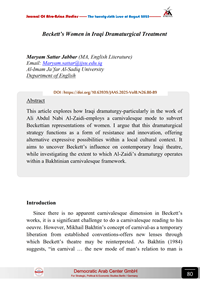
Beckett’s Women in Iraqi Dramaturgical Treatment
DOI:
https://doi.org/10.63939/JAAS.2025-Vol8.N26.80-89Keywords:
Iraqi Contemporary Theatre, Carnivalesque, Gender Representation, Female ResistanceAbstract
This article explores how Iraqi dramaturgy-particularly in the work of Ali Abdul Nabi Al-Zaidi-employs a carnivalesque mode to subvert Beckettian representations of women. I argue that this dramaturgical strategy functions as a form of resistance and innovation, offering alternative expressive possibilities within a local cultural context. It aims to uncover Beckett’s influence on contemporary Iraqi theatre, while investigating the extent to which Al-Zaidi’s dramaturgy operates within a Bakhtinian carnivalesque framework.
References
Abdulahmeed,Sami. (2010). Lights on the Theatrical Life in Iraq. Baghdad: A Mada publishing Company. Print.
Al Shammari, Alyaa. A. N. (2016). Iraq in Contemporary Drama: A Study of Selected Plays of and About Iraq, 1990-2013. The University of Sheffield.
Al Sharji, Ahmed.(2013). Arabic Theatre from Borrowing to Imitation. Baghdad: Adnan Publishing. Print.
Amine, Khalid.(2006). “Theatre in the Arab World: A Difficult Birth” Theatre Research International. 2.31: 145-162. Print. DOI: https://doi.org/10.1017/S0307883306002094
Bakhtin, M. M. (1984). Rabelais and His World (H. Iswolsky, Trans.). Bloomington: Indiana University Press.
Downloads
Published
Issue
Section
License
Copyright (c) 2025 Maryam Sattar Jabbar

This work is licensed under a Creative Commons Attribution-NonCommercial 4.0 International License.