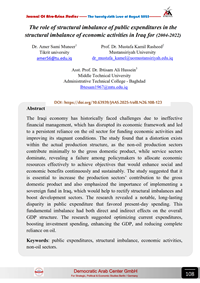
The role of structural imbalance of public expenditures in the structural imbalance of economic activities in Iraq for (2004-2022)
DOI:
https://doi.org/10.63939/JAAS.2025-Vol8.N26.108-123Keywords:
public expenditures, structural imbalance, economic activities, non-oil sectors.Abstract
The Iraqi economy has historically faced challenges due to ineffective financial management, which has disrupted its economic framework and led to a persistent reliance on the oil sector for funding economic activities and improving its stagnant conditions. The study found that a distortion exists within the actual production structure, as the non-oil production sectors contribute minimally to the gross domestic product, while service sectors dominate, revealing a failure among policymakers to allocate economic resources effectively to achieve objectives that would enhance social and economic benefits continuously and sustainably. The study suggested that it is essential to increase the production sectors’ contribution to the gross domestic product and also emphasized the importance of implementing a sovereign fund in Iraq, which would help to rectify structural imbalances and boost development sectors. The research revealed a notable, long-lasting
disparity in public expenditure that favored present-day spending. This fundamental imbalance had both direct and indirect effects on the overall GDP structure. The research suggested optimizing current expenditures, boosting investment spending, enhancing the GDP, and reducing complete reliance on oil.
References
Abdul Karim Jaber, 2012, International Finance (A Modern Introduction), first edition, Dar Al-Safa for Publishing and Distribution, Jordan.
Adnan Hussein Younis et al., 2017, Structural Imbalances in Rentier States, Dar Al-Ayyam for Publishing and Distribution, first edition, Jordan.
Ali Majeed Al Hammadi, 1989, "The Industrial Structure in the Gulf Cooperation Council Countries," Industrial Cooperation Journal, Issue 36.
Fadhila Januhan, 2006, The Problem of External Debt and Its Effects on Economic Development in Arab Countries: The Case of Some Indebted Countries, Faculty of Administration, Economics, and Management Sciences, University of Algiers, Algeria.
Hassan Hadi Saleh, 2007, The Role of Foreign Direct Investment in Correcting Structural Imbalances in Light of International Developments, Al-Mustansiriya University, Iraq.
Hossam Ayed Safouk, 2023, The Role of Industrial Exports in Addressing Structural Imbalances (Experiences of Selected Countries with Reference to Iraq), Faculty of Management and Economics, University of Karbala, Iraq.
Hussein Shanawa Majeed, 2011, Structural Imbalances in the Iraqi Economy, Al-Kut Journal of Economic and Administrative Sciences, Volume 1, Issue 5, Iraq.
Kamel Badan Saleh, 2012, Predicting Structural Imbalances in the Arab Economic Structure in Light of Globalization for the Period (1985-2030), St. Clements University, Iraq.
Ramzi Zaki, 1980, "The Problem of Inflation in Egypt," Egyptian General Book Organization, First Edition, Egypt.
Saad Mahmoud Al-Kawaz and Samir Hanna Bahnam, 2010, The Impact of Structural Change on International Trade for a Selected Sample of Developing Countries for the Period (1985-2008), Rafidain Development Journal, Volume 32, Issue 101, University of Mosul. DOI: https://doi.org/10.33899/tanra.2010.161843
Salem Ali Al-Jundi, 1995, The Private Sector in Iraq: A Development Vision, College of Administration and Economics, University of Basra, Iraq.
Salem Tawfiq Al-Najfi, 2002, Structural Stabilization and Adjustment Policies and Their Impact on Arab Economic Integration, Bayt Al-Hikma, First Edition, Iraq.
Samir Khalaf Bandar, 2018, External Economic Shocks and Options for Addressing Their Structural Effects – Selected Experiences with Special Reference to Iraq (2003-2014), College of Administration and Economics, Al-Mustansiriya University, Iraq.
Downloads
Published
Issue
Section
License
Copyright (c) 2025 Amer Sami Muneer et al.

This work is licensed under a Creative Commons Attribution-NonCommercial 4.0 International License.