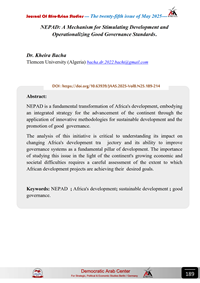
NEPAD: A Mechanism for Stimulating Development and Operationalizing Good Governance Standards.
DOI :
https://doi.org/10.63939/JAAS.2025-Vol8.N25.189-214Mots-clés :
NEPAD ; Africa's development; sustainable development ; good governance.Résumé
NEPAD is a fundamental transformation of Africa's development, embodying an integrated strategy for the advancement of the continent through the application of innovative methodologies for sustainable development and the promotion of good governance.
The analysis of this initiative is critical to understanding its impact on
changing Africa's development tra jectory and its ability to improve
governance systems as a fundamental pillar of development. The importance of studying this issue in the light of the continent's growing economic and societal difficulties requires a careful assessment of the extent to which African development projects are achieving their desired goals.
Références
1. Adebajo, A.Landsberg, C. (2003). South Africa and Nigeria as regional hegemons. In M. Baregu. C. Landsberg (Eds.), From Cape to Congo: Southern Africa's evolving security challenges (pp. 171-203). Lynne Rienner. DOI: https://doi.org/10.1515/9781685855215-011
2. Adesina, J. O. (2004). NEPAD and the challenge of Africa's development: Towards the political economy of a discourse. Society in Transition, 35(1), 125-144. DOI: https://doi.org/10.1080/21528586.2004.10419110
3. Adejumobi, S. (2006). Governance and poverty reduction in Africa: A critique of the Poverty Reduction Strategy Papers (PRSPs). In A. G. Obiozor . O. C. Eze (Eds.), Africa and the challenges of development (pp. 71-92). Nigerian Institute of International Affairs.
4. Adogamhe, P. G. (2008). Pan-Africanism revisited: Vision and reality of African unity and development. African Review of Integration, 2(2), 1-34.
5. Akokpari, J. K. (2004). The AU, NEPAD and the promotion of good governance in Africa. Nordic Journal of African Studies, 13(3), 243-263.
6. Ake, C. (1996). Democracy and development in Africa.Brookings Institution Press.
7. APRM Secretariat. (2023).Status of APRM implementation in participating countries. African Peer Review Mechanism.
8. Asante, S. K. B. (1997).Regionalism and Africa's development: Expectations, reality and challenges. Macmillan.
9. Badiane, O., Odjo, S. Ulimwengu, J. (2011). Emerging policies and partnerships under CAADP: Implications for long-term growth, food security, and poverty reduction. IFPRI Discussion Paper 1145. International Food Policy Research Institute.
10. Baimu, E. (2002). The African Union: Hope for better protection of human rights in Africa?African Human Rights Law Journal, 2(2), 299-326.
11. Besada, H., Whelan, J., & Tok, E. (2013). Rwanda's APRM review: A pathway to comprehensive governance. Journal of Contemporary African Studies, 31(2), 268-286.
12. Bing-Pappoe, A. (2010). Reviewing Africa's peer review mechanism: A seven country survey. Partnership Africa Canada.
13. Brixiová, Z., Ndikumana, L.Youm, K. (2011). Modernizing development finance for the 21st century: Public-private partnerships in mobilizing resources for development. In E. Aryeetey, S. Devarajan, R. Kanbur, & L. Kasekende (Eds.), The Oxford companion to the economics of Africa (pp. 433-440). Oxford University Press.
14. Byamugisha, F. F. K. (2013). Securing Africa's land for shared prosperity: A program to scale up reforms and investments. World Bank. DOI: https://doi.org/10.1596/978-0-8213-9810-4
15. Chabal, P. (2002). The quest for good government and development in Africa: Is NEPAD the answer? International Affairs, 78(3), 447-462. DOI: https://doi.org/10.1111/1468-2346.00260
16. Déme, O. (2005). Between hope and skepticism: Civil society and the African Peer Review Mechanism. Partnership Africa Canada Discussion Paper. Partnership Africa Canada.
17. Draper, P. (2010). Rethinking the (European) foundations of sub-Saharan African regional economic integration: A political economy essay. OECD Development Centre Working Paper No. 293. OECD
Publishing.
18. Ekwealor, C. T. (2013). The New Partnership for Africa's Development (NEPAD): An empirical analysis of the conditions of success. Unpublished doctoral dissertation, University of KwaZulu-Natal.
19. Engel, U. (2010). The African Peer Review Mechanism revisited: The APRM as a power resource and legitimation tool. In U. Engel & J. G. Porto (Eds.), Africa's new peace and security architecture: Promoting norms, institutionalizing solutions (pp. 127-148). Ashgate.
20. Foster, V. Briceño-Garmendia, C. (Eds.). (2010). Africa's infrastructure: A time for transformation. World Bank. DOI: https://doi.org/10.1596/978-0-8213-8041-3
21. Grimm, S., & Nawrath, K. (2007). The African Peer Review Mechanism – Lessons from the pioneering phase. DIE Working Paper. German Development Institute.
22. Gruzd, S. (2014). The African Peer Review Mechanism: Development lessons from Africa's remarkable governance assessment system. SAIIA Research Report 15. South African Institute of International Affairs.
23. Haas, E. B. (1958). The uniting of Europe: Political, social, and economic forces 1950-1957. Stanford University Press.
24. Hope, K. R. (2005). Toward good governance and sustainable development: The African Peer Review Mechanism. Governance, 18(2), 283-311. DOI: https://doi.org/10.1111/j.1468-0491.2005.00276.x
25. Jakobeit, C. (2006). Implementing NEPAD: A critical assessment. The African Development Perspectives Yearbook, 11, 143-159.
26. Jordaan, E. (2006). Inadequately self-critical: Rwanda's self-assessment for the African Peer Review Mechanism. African Affairs, 105(420), 333-351. DOI: https://doi.org/10.1093/afraf/adi124
27. Juma, C. (Ed.). (2011). The new harvest: Agricultural innovation in Africa. Oxford University Press.
28. Kolavalli, S., Birner, R., Benin, S., Horowitz, L., Babu, S., Asenso-Okyere, K., Thompson, N. M. Poku, J. (2010). Institutional and public expenditure review of Ghana's Ministry of Food and Agriculture. IFPRI Discussion Paper 01020. International Food Policy Research Institute.
29. Kumo, W. L. (2012). Infrastructure investment and economic growth in South Africa: A Granger causality analysis. African Development Bank Working Paper Series No. 160. African Development Bank.
30. Landsberg, C. (2012). Towards a post-apartheid South African foreign policy review. In C. Landsberg J.-A. van Wyk (Eds.), South African foreign policy review (pp. 1-27). Africa Institute of South Africa.
31. Matlosa, K. (2014). Pan-Africanism, the African Peer Review Mechanism and the African Charter on Democracy, Elections and Governance: What does the future hold?South African Institute of International Affairs Occasional Paper No. 190. South African Institute of International Affairs.
32. Mkandawire, T. (2001). Thinking about developmental states in Africa. Cambridge Journal of Economics, 25(3), 289-314. DOI: https://doi.org/10.1093/cje/25.3.289
33. Mkandawire, T. (2007).Good governance': The itinerary of an idea. Development in Practice, 17(4-5), 679-681. DOI: https://doi.org/10.1080/09614520701469997
34. Mutai, H. K. (2011). Regional trade integration strategies under SADC and the EAC: A comparative analysis. SADC Law Journal, 1(1), 81-97.
35. Ndulu, B. J. (2006). Infrastructure, regional integration and growth in sub-Saharan Africa: Dealing with the disadvantages of geography and sovereign fragmentation. Journal of African Economies, 15(Supplement 2), 212-244. DOI: https://doi.org/10.1093/jae/ejl033
36. Ndulu, B., Chakraborti, L., Lijane, L., Ramachandran, V., & Wolgin, J. (2005). Challenges of African growth: Opportunities, constraints, and strategic directions. World Bank.
37. NEPAD. (2001).The New Partnership for Africa's Development. NEPAD Secretariat.
38. NEPAD. (2003).Action plan for the environment initiative. NEPAD Secretariat.
39. NEPAD. (2007).Governance in Africa's development: Progress, prospects and challenges. NEPAD Secretariat.
40. NEPAD. (2015).Presidential Infrastructure Champion Initiative (PICI) report. NEPAD Agency.
41. North, D. C. (1990).Institutions, institutional change and economic performance. Cambridge University Press. DOI: https://doi.org/10.1017/CBO9780511808678
42. Olukoshi, A. (2002). Governing the African political space for sustainable development: A reflection on NEPAD. In NEPAD: A new path? Heinrich Böll Foundation.
43. Rostow, W. W. (1960).The stages of economic growth: A non-communist manifesto. Cambridge University Press.
44. Taylor, I. (2005). NEPAD: Towards Africa's development or another false start? Lynne Rienner. DOI: https://doi.org/10.1515/9781626371163
45. Tieku, T. K. (2004). Explaining the clash and accommodation of interests of major actors in the creation of the African Union. African Affairs, 103(411), 249-267. DOI: https://doi.org/10.1093/afraf/adh041
46. Turianskyi, Y. (2017).Evolution not revolution: A critical analysis of the APRM reform process. South African Institute of International Affairs.
47. World Bank. (1992).Governance and development. World Bank.
48. Zimmermann, F. Smith, K. (2011). More actors, more money, more ideas for international development co-operation. Journal of International Development, 23(5), 722-738. DOI: https://doi.org/10.1002/jid.1796
49. Zorbas, E. (2011). Aid dependence and policy independence: Explaining the Rwandan paradox. In S. Straus L. Waldorf (Eds.), Remaking Rwanda: State building and human rights after mass violence(pp. 103-117). University of Wisconsin Press. DOI: https://doi.org/10.2307/jj.36106120.14
Téléchargements
Publiée
Numéro
Rubrique
Licence
Merci de créditer les auteurs lors de toute citation : Bacha Kheira (2025)

Ce travail est disponible sous licence Creative Commons Attribution - Pas d’Utilisation Commerciale 4.0 International.