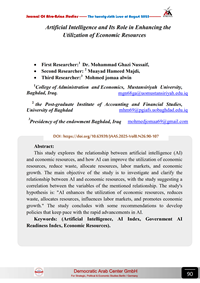
Artificial Intelligence and Its Role in Enhancing the Utilization of Economic Resources
DOI:
https://doi.org/10.63939/JAAS.2025-Vol8.N26.90-107Keywords:
Artificial Intelligence, AI Index, Government AI Readiness Index, Economic ResourcesAbstract
This study explores the relationship between artificial intelligence (AI) and economic resources, and how AI can improve the utilization of economic resources, reduce waste, allocate resources, labor markets, and economic growth. The main objective of the study is to investigate and clarify the relationship between AI and economic resources, with the study suggesting a correlation between the variables of the mentioned relationship. The study's hypothesis is: "AI enhances the utilization of economic resources, reduces waste, allocates resources, influences labor markets, and promotes economic growth." The study concludes with some recommendations to develop policies that keep pace with the rapid advancements in AI.
References
2. Mercadé Melé, Pere, Molina Gómez, Jesús, Sousa, Maria José. "Technology, governance, and a sustainability model for small and medium-sized towns in Europe". 'MDPI AG', 2020, https://core.ac.uk/download/322918717.pdf
3. Zhuge, Hai. "Mapping Big Data into Knowledge Space with Cognitive Cyber-Infrastructure".
2015, http://arxiv.org/abs/1507.06500
4. https://taqadom.aspdkw.com/ الثورات الصناعية الأرب ع: إطلالة تاريخية - مجلة التقدم العليم - ملف العدد
5. Romer, Paul. (1990). "Endogenous Technological Change". Journal of Political Economy. DOI: https://doi.org/10.3386/w3210
6. Solow, Robert M. (1956). "A Contribution to the Theory of Economic Growth". The Quarterly Journal of Economics. DOI: https://doi.org/10.2307/1884513
7. Brynjolfsson, Erik, and McAfee, Andrew. (2014). "The Second Machine Age: Work, Progress, and Prosperity in a Time of Brilliant Technologies."
8. Schumpeter, Joseph A. (1942). "Capitalism, Socialism, and Democracy."
9. Porter, Michael E. (1985). "Competitive Advantage: Creating and Sustaining Superior Performance."
10. Daly, Herman E. (1991). "Steady-State Economics: Second Edition."
11. Christensen, Clayton. (1997). "The Innovator's Dilemma."
12. Becker, Gary S. (1964). "Human Capital: A Theoretical and Empirical Analysis, with Special Reference to Education."
-SAP .https://www.sap.com/mena| يف الأعمال AI | ما هو الذكاء الاصطنايع؟ .13 ar/products/artificial-intelligence/what-is-artificial-intelligence.html
14. https://www.tortoisemedia.com/intelligence/global-ai
15. https://oxfordinsights.com/ai-readiness/ai-readiness-index/
16. About Us | Brookings https://www.brookings.edu/articles/what-should-be-done-about-the-growing-influence-of-industry-in-ai-research/#:~:text=%2D%20Data%20%28Shokri%20and,deep%20learning%2C%20the%20larger
17. Leveraging AI in Business: 3 Real-World Examples .https://online.hbs.edu/blog/post/ai-in-business#:~:text=This%20predictive%20capability%20allows,reducing%20the%20likelihood%20of
18. Exploring the Impact of AI on Various Industries .https://www.linkedin.com/pulse/exploring-impact-ai-various-
industries-tanet#:~:text=In%20the%20healthcare%20industry%2C,care%2C%20and%20accelerating%20drug
19. 131 AI Statistics and Trends for (2024) | National University .https://www.nu.edu/blog/ai-statistics-
trends/#:~:text=The%20manufacturing%20sector%20will,of%20IT%20and%20telecom
21. Studies and Planning for Center Bayan-A. https://www.bayancenter.org/wp-content/uploads/2022/04/8rfgyh2.pdf
Downloads
Published
Issue
Section
License
Copyright (c) 2025 Mohammad Ghazi Nussaif et al.

This work is licensed under a Creative Commons Attribution-NonCommercial 4.0 International License.