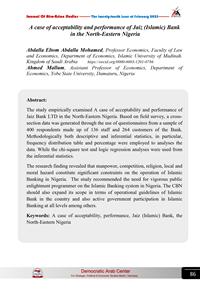
A case of acceptability and performance of Jaiz (Islamic) Bank in the North-Eastern Nigeria
DOI :
https://doi.org/10.63939/JAAS.2025-Vol8.N24.86-144Mots-clés :
A case of acceptability, performance, Jaiz (Islamic) Bank, the North-Eastern NigeriaRésumé
The study empirically examined A case of acceptability and performance of Jaiz Bank LTD in the North-Eastern Nigeria. Based on field survey, a cross-section data was generated through the use of questionnaires from a sample of 400 respondents made up of 136 staff and 264 customers of the Bank. Methodologically both descriptive and inferential statistics, in particular, frequency distribution table and percentage were employed to analyses the data. While the chi-square test and logic regression analyses were used from the inferential statistics.
The research finding revealed that manpower, competition, religion, local and moral hazard constitute significant constraints on the operation of Islamic Banking in Nigeria. The study recommended the need for vigorous public enlightment programmer on the Islamic Banking system in Nigeria. The CBN should also expand its scope in terms of operational guidelines of Islamic Bank in the country and also active government participation in Islamic Banking at all levels among others.
Références
1. Abdul Majid, A., R. (2003) ‘Development of Liquidity Management Instrumnets: Challenges and
2. Abdullah N.I, (2007), “Issues of Implementing Hire Purchase in Dual Banking Systems: Malaysia’s Experience.” Thunderbird International Business Review, Vol. 49(2) 225 -249 Finance and Economics. Vol 1, No 1 Financial Priorities”. Paper No. 2977, posted 07. November
3. Adam Smith (1776). The Wealth of Nation, quoted in Rima I.M (1980) development of economic analysis (3rd ed) London; Richard D. Irwin.
4. Adebayo, R.I. (2010). “The motivating factors for the viability of Islamic Banking in Nigeria” in journal of Islamic Banking and finance, Vol. 27. No 2 April-June. Pp. 93-109.
5. Ahmad, A. &Hassan, H. (2007), “Regulations and Performance of Islamic Banking in Bangladesh”. Thunderbird International Business Review, Vol. 49(2) 251–277 DOI: https://doi.org/10.1002/tie.20142
6. Ahmad, A. U. F., and Hassan, M. K. (2007) ‘The Time Value of Money Concept in Islamic Finance’,the American Journal of Islamic Social Sciences, Vol. 23, No.1 DOI: https://doi.org/10.35632/ajiss.v23i1.436
7. Ahmed. S, (1987). Islamic Banking, financial and insurance; A global overview Malaysia: A.S noordeen press.
8. Ahsan, A.S.M (1988) “Islamic Banking in perspective” in molla R.I et al., (eds.) frontiers and mechanics of Islamic Economics Sokoto. University of sokoto press.
9. Aisha,F & Raza, T. (2006)” Contemporary practices of Islamic financing Techniques” Islamic Economic Studies, I(2 june) pp.5-52
10. Algaoud, L.M. and Lewis, M.K. (2007) ‘Islamic critique of conventional financing’, in the Handbook of Islamic Banking, M. Kabir Hassan and M.K. Lewis (eds.), Edward Elgar, Cheltenham, UK and Northampton, Mass, pp. 38-48. DOI: https://doi.org/10.4337/9781847205414.00011
11. Aliero I. H. (1993). “Theory of Interest in Secular Economics a Critical Survey” in Gasau S.A and Basher, M.L (eds.) reading in Islamic economic vol.2, Department of Economics University of Sokoto.
12. Aliero, H. I. (2004). “A Study of Rotating Saving and Credit Association (ROSCA) in Sokoto Metropolis with Reference to Islamic Financing System fro Small-scale Enterprises” Ph.D thesis (Unpublished), Submitted to Postgraduate School, Usmanu Danfodiyo University Sokoto Pp. 70-74. Asian Business, vol.11, pp. 26.
13. Aliyu, C.U. (1988). “Problems of organizing Islamic Banking in Nigeria. A case study of Sokoto metropolis. A research paper (unpublished) submitted to the Department of Economics, Sokoto UDUS.
14. Aliyu, C.U. (2010). “Shariah and corporate Governance in Non Interest (Islamic) Banking” A paper presented at one-day sensitization seminar on Non-interest Banking in Nigeria. Organized by Nigeria deposit insurance corporation (NDIC), held at transecorp Hilton Hotel, Abuja, Nov. 24th.
15. Al-Jarhi, M. A. (2005) ‘The Case for Universal Banking as a Component of Islamic Banking’,
16. Al-Jarhi, M. A. (2009) ‘Islamic finance: an efficient & equitable option’, The Islamic Research and Training Institute, IDB. Jeddah, Saudi Arabia
17. Al-Jarihi, M., A., and Iqbal. M. (2001) ‘Islamic Banking: Answers to Some Frequently Asked Questions’, Islamic Development Bank (IDB). Occasional Paper No.4.
18. AL-saati, A. (2003) ‘The Permissible Gharar (Risk) in Classical Islamic Jurisprudence’, J.KAU:IslamicEcon.,Vol. 16, No. 2, pp. 3-19. DOI: https://doi.org/10.4197/islec.16-2.1
19. , M. (2007) ‘Understanding Islamic Finance’, John Wiley and Sons Ltd. England
20. Bawa, M. (1993). “Proposal for establishing Islamic Banks in Nigeria” Gusau, S.A and Bashir M.L. A (eds) Readings in Islamic economics. Vol. 2. Department of Economics Usumanu Danfadiyo University, Sokoto pp. 78-98.
21. Bellalah, M. and Ellouz, S. (2004) Islamic Finance, Interest Rates and Islamic Banking: A survey of the literature. Finance India, 18, pp533.
22. Benjelloun, H. (2010) ‘Financial leverage and the channeling of resources: profit loss sharing under the framework of Islamic financial institutions’, Banks and Bank Systems, Vol. 5, Issue 4
23. Bleher, S., M. (2008) ‘The facts about Usury: Why Islam is Against Lending Money at Interest', Islamic Party of Britain. Islamic Awareness. Available at: http://www.islamicawareness.org/History/usury.html (accessed 17 March. 2009)
24. Chapra, M. U. (1983). Islamic and Economic Challenge, Islamic Foundation and International Institute of Islamic Thought.
25. Chapra, M., U., and Ahmed, H. (2002) ‘Corporate Governance in Islamic Financial Institutions’, Islamic Development Bank, Occasional paper No. 6.
26. El-Gamal, M., A. (2003) ‘Interest and the Paradox of Contemporary Islamic Law and Finance', Fordham International Law Journal, Vol. 27, Issue 1.
27. Elmelki, A., and Ben Arab, M. (2009) ‘Ethical Investment and the Social Responsibilities of the Islamic Banks’, International Business Research, Vol.2, No.2 DOI: https://doi.org/10.5539/ibr.v2n2p123
28. Faud, A. and Mohammad, A. (1996). Islamic Banking Theory Practice and Challenge. Karachi: Oxford University Press.
29. Friedman, M. (1969). Price theory, 2nd (ed), Mew York: Aldine Press.
30. Garas, N.S, (2007), “Internationalization of Islamic Financial Institution. Challenges and paths to Solution”. Thunderbird International Business Review, Vol. 49(2)pp. 225–249. DOI: https://doi.org/10.1002/tie.20141
31. Gusau S.A and Bawa, M.A. (1993) “An Alternative Strategy of Solving Some of the Problems of Nigeria`s Financial system: A Case for Islamic Banking in Nigeria. “In Reading in Islamic Economics. Vol.2 Department of Economics Usmanu
Danfodiyo University, Sokoto.pp.49-77.
32. Gusau, S. A (2000). “Interest - Free Banking System Theory and Practice” a Paper Presented in a Seminar on the Problems and Prospect of Interest- Free Banking System in Nigeria Organize by the SIA Management Consultants, at the Royal Tropicana Hotel Kano 1st -3rd August.
33. Gusau, S.A. (1986). “Prospects of Islamic Banking in Nigeria”. A Paper Presented at the National Seminar on Islamic Banking, Organized by the Islamic Education Trust Minna.
34. Hanson, L.J.(1980). A Textbook of Economics, 4th London; MacDonald Evans.
35. Haque A; Osman,J;and Ismail, A.Z. (2009).’Factors Influence Selection of Islamic Banking: A Study on Malaysian Customer Perspective”, American Journal of Applied Sciences. Vol. 6 (5).pp.922-928. DOI: https://doi.org/10.3844/ajas.2009.922.928
36. Hassan, K., and Kayed, R. (2009) ‘The global financial crisis, risk management and social justice in Islamic finance’, ISRA International Journal of Islamic Finance, Vol. 1, Issue 1 DOI: https://doi.org/10.55188/ijif.v1i1.63
37. Hassan, Z. (1992). “Determination of Profit and Loss Sharing Rates in Interest Free Business Finance, Journal of Research in Islamic Economic, vol.3 no 1 pp. 13-27.
38. Hosein. I. M. (1996). The Importance of the Prohibition of Riba in Islam Malaysia; Ummavision Resource.
39. Iqbal, J. (2009). Islamic Financial Management’, Global Vision Publishing House, New Delhi.
40. Iqbal, M. (2001), “Islamic and Conventional Banking in Nineties”. A Comparative Study. Islamic Economic StudiesVol.8, No.2, April 2001.
41. Iqbal, Z. (1997) ‘Islamic Financial Systems’, Finance & Development, Vol. 34, pp. 42-45.
42. Iqbal,M, Ahmed,U & Khan,A (1998). “Challenges Facing by Islamic Banking”. 95 pages – 17x24 Cm. Islamic Economy Legal Deposit No. 2282/19 ISBN: 9960-32-065-0 Islamic Research and Training Institute Islamic Development Islamic
Economic Studies, Vol. 12, No.
43. Joshi, M. M. (2005) “Access to credit by Hawkers: what is missing? Theory and evidence” Ph.D. thesis submitted to the Department of Agricultural Economic, Ohio University.
44. Karbhari, Y. Naser, K.& Shahin, Z. (2004)“Problem and Challenges Facing the Islamic Banking System in the west. The case of the UK.” Thunderbird International Business Review, Vol. 46(5) 521–543. DOI: https://doi.org/10.1002/tie.20023
45. Kettell, B. (2011) ‘Introduction to Islamic Banking and Finance’, 1st edition, Wiley Finance, UK DOI: https://doi.org/10.1002/9781118467299
46. Khan, F. (1984) ‘Comments on Volker Nienhaus: Profitability of Islamic Banks Competing with Interest Banks’, JRIE, Vol. 1, No.1, Summer 1983’, J. Res. Islamic Econ., Vol. 1, No. 2, pp. 69-73
47. Khan, F. (2006) Financial Modernization in 21st Century and Challenge for Islamic Banking International Journal of Islamic Financial Service Vol.1 no3Ma”Ariful Quran.
48. Klein, L. (2001). The Keynesian Revolution, London: MacMillan Press.
49. Luca, E., and Vasudevan, S. (2002) ‘Islamic Financial Institutions and Products in the Global
50. Malami, H. U. (1992). “Need and prospects of Islamic Bank in Nigeria, unpublished researched paper submitted to the faculty of Economics and management, International Islamic University Malaysia.
51. Malami, H.U (1992). “Prospect of Islamic Banking inn he Muslim Minority Communities” in Journal Institute of Muslim Minority Affairs, Vol. XIII. No. 11 July, pp. 308-315. DOI: https://doi.org/10.1080/02666959208716250
52. Mannan, M.A (1976). Islamic theory of capital and interest Karachi; Darul irshad publisher..
53. Manzur, (1986). Riba (Usury or Interest). Its condemnation by the Shariah Islamic Law ad a Proposed Alterative. Jidda, International Islamic Publishing House.
54. Obaidullah, M. (2009) ‘Some Issues InShari’ah Compliance & Regulation of Islamic Funds’, DOI: https://doi.org/10.4197/Islec.22-1.4
55. Pirbram,K. (1983). A history of economic reasoning U.SA johns Hopkins University press.
56. Qureshi A.I (1945). Islam and theory of invest. New Delhi: kitab Bhavan press. Review of Islamic Economics. Vol. 2, No. 1, pp. 1 - 29.
57. Samuelson, P. A. and Nordhaus, O. (2002).economics, (13th edition) London: McGraw hill Inc.
58. Sanusi, L. S. (2011). “Guideline for the Regulation and Supervision of Institutions Offering Islamic Financial Service (IIFS) in Nigeria in Leadership Newspaper, Wednesday June 22 pp. 1-5.
59. Sarker, A., A. (2006) ‘CAMELS Rating System in the Context of Islamic Banking: A Proposed 'S'forShari‘ah Framework’, Journal of Islamic Economics and Finance, Vol. 1, No.1, pp. 78-84.
60. Schacht, J. (1964) ‘An Introduction to Islamic Law’, Clarendon Press, Oxford.
61. Shafi, M. and Usmani, T. (1997) the Issue of Interest, Pakistan, Darul Ishaa.
62. Shahid, S. (2007) ‘Role of Islamic banks in economic development’, MPRA Paper No.7332. Dec.
63. Siddiqi, M. N. (1983). “Islamic Finance and Beyond Premises and Promise of Islamic Economic, Journal of Islamic Banking and Finance 2(1) Jan-Mar, 59-67.
64. Siddiqi, M. N. (2008) ‘Current Financial Crisis and Islamic Economics’, Oct. Available at:
65. Siddiqi, M.N. (1983). Issues in Islamic Banking Concester. The Islamic foundation.
66. Sundararajan, V., and Errico, L. (2002) ‘Islamic Financial Institutions and Products in the Global Financial System: Key Issues in Risk Management and Challenges Ahead’, IMF Working Paper No. 02/192. Available at: http://www.imf.org/external/pubs/ft/wp/2002/wp02192.pdf (accessed 26 May. 2010) DOI: https://doi.org/10.5089/9781451859775.001
67. Uhlig, H. (2000) ‘Should We be Afraid of Friedman’s Rule’, Journal of the Japanese and DOI: https://doi.org/10.1006/jjie.2000.0453
68. Usmani M.(2005) An Introduction to Islamic Finance Pakistan:maktaba.
69. Usmani, M. T. (2005) ‘An Introduction to Islamic Finance’, IdaraIsha'at-E-Diniyat (P) Ltd
70. World Takaful report. (2008) ‘Highlighting a new growth opportunity in Islamic finance’, Electronic copy available
71. Zainal, M., P. (2009) ‘Insuring Shari’ah Based Deposits’, The Deposit Insurance.
Téléchargements
Publiée
Numéro
Rubrique
Licence
Merci de créditer les auteurs lors de toute citation : Eltom Abdalla Mohamed et al. (2025)

Ce travail est disponible sous licence Creative Commons Attribution - Pas d’Utilisation Commerciale 4.0 International.