Guardians of Truth in Algerian Academia: Developing Ethical AI Frameworks for Multilingual Hypothesis-Driven Research
DOI :
https://doi.org/10.63939/JAAS.2026-Vol9.N30.62-77Mots-clés :
artificial intelligence ethics, multilingual research, academic integrity, EFL research, higher educationRésumé
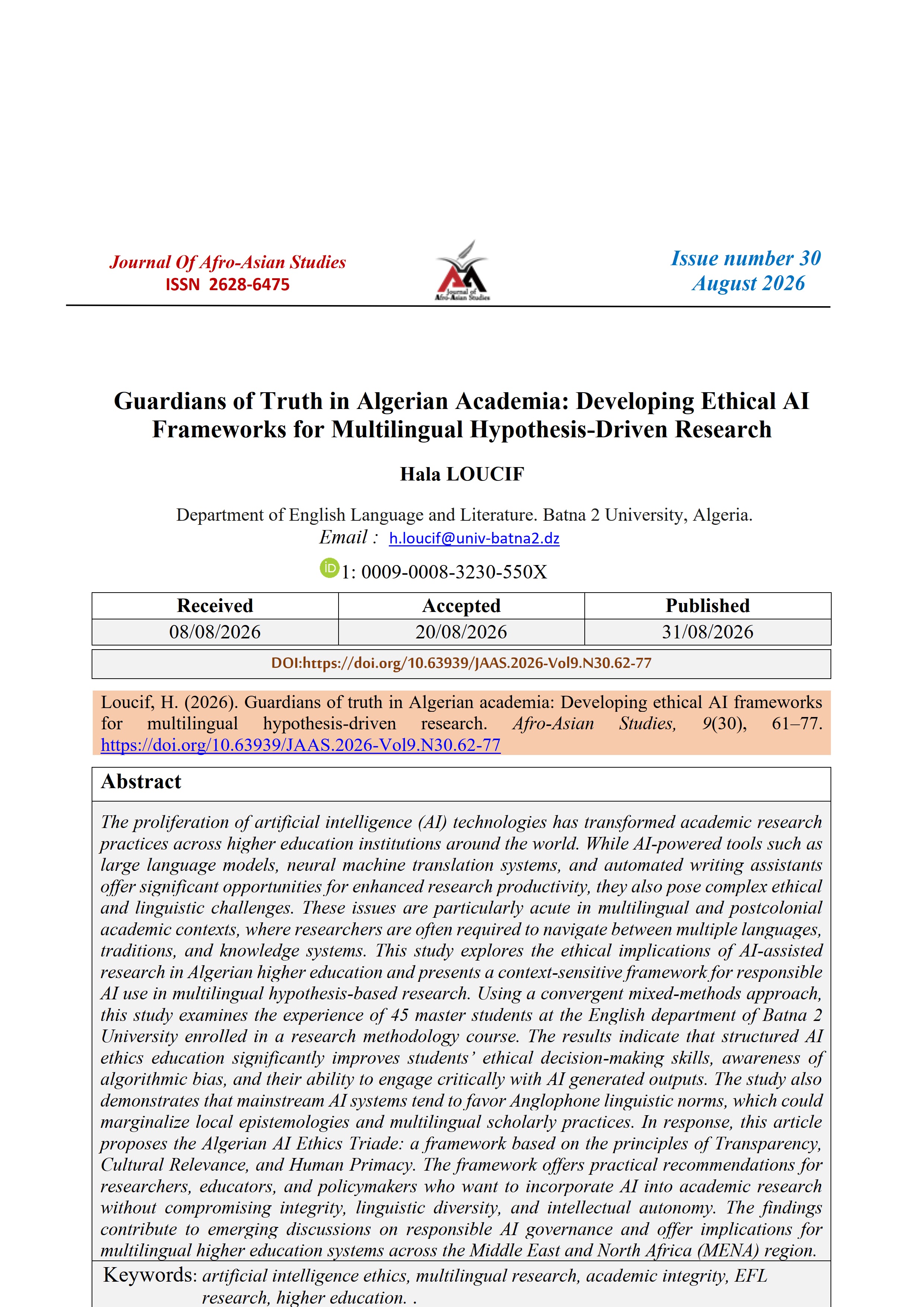
The proliferation of artificial intelligence (AI) technologies has transformed academic research practices across higher education institutions around the world. While AI-powered tools such as large language models, neural machine translation systems, and automated writing assistants offer significant opportunities for enhanced research productivity, they also pose complex ethical and linguistic challenges. These issues are particularly acute in multilingual and postcolonial academic contexts, where researchers are often required to navigate between multiple languages, traditions, and knowledge systems. This study explores the ethical implications of AI-assisted research in Algerian higher education and presents a context-sensitive framework for responsible AI use in multilingual hypothesis-based research. Using a convergent mixed-methods approach, this study examines the experience of 45 master students at the English department of Batna 2 University enrolled in a research methodology course. The results indicate that structured AI ethics education significantly improves students’ ethical decision-making skills, awareness of algorithmic bias, and their ability to engage critically with AI generated outputs. The study also demonstrates that mainstream AI systems tend to favor Anglophone linguistic norms, which could marginalize local epistemologies and multilingual scholarly practices. In response, this article proposes the Algerian AI Ethics Triade: a framework based on the principles of Transparency, Cultural Relevance, and Human Primacy. The framework offers practical recommendations for researchers, educators, and policymakers who want to incorporate AI into academic research without compromising integrity, linguistic diversity, and intellectual autonomy. The findings contribute to emerging discussions on responsible AI governance and offer implications for multilingual higher education systems across the Middle East and North Africa (MENA) region.
Téléchargements
Publiée
Numéro
Rubrique
Licence
(c) Copyright Revue des études Afro-Asiatiques 2026

Ce travail est disponible sous licence Creative Commons Attribution - Pas d’Utilisation Commerciale 4.0 International.